
EpiAge test kit for the precise determination of your biological = epigenetic age
The only age that counts is your biological DNA age.
What is your actual age and how healthy are you really?
Everyone ages at a different pace, even identical twins!
Common age related diseases begin decades before becoming symptomatic and diagnosis in the early stages of disease is mostly not possible. After diagnosis, following a diagnostically silent period, cellular damage is already fully developed. Examples for this are many widespread age-related diseases such as Alzheimers’s dementia, Parkinson’s disease, depression and age-related diabetes.
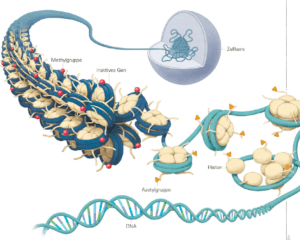
Bild rechts: methyl groups (red circles) attached to hereditary DNA (DNA and histones)
What are the reasons for this?
Epigenetics determines your true biological age and is the underlying cause of state of health and your future life expectancy.
The “methylation status” of your DNA starts decreasing in early adult hood. This “hypomethylation” of your DNA is caused by an age related deficiency of ademetionine produce naturally in your body. Methylation of your DNA is solely dependent on ademetionine and the resulting lack of methyl groups for DNA methylation will affect your well-being and your life expectancy.
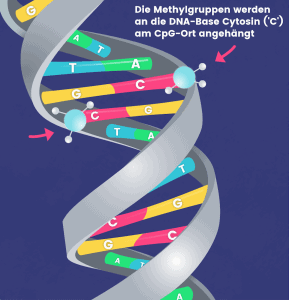
Bild: Methyl groups attach to cytosin in DNA
The DNA methylation status determines your “biological age” and can differ significantly from your “chronological age”.
It is absolutely possible for some to “look and feel” older than their chronological age while others are biologically younger than their chronological age.
A change in paradigm in the search of biological age markers followed Horvath’s hypothesis of an “epigenetic clock”. Here, DNA methylation status is measured across 500 strategic positions in your DNA.
Studies have indicated that an accelerated “epigenetic clock” in adults could be linked to a higher risk of developing several age-related chronic diseases such as neurodegenerative and psychiatric diseases, cardiovascular disease and cancer (https://www.ncbi.nlm.nih.gov/pubmed/?term=epigenetic+clock+disease, https://epigenetik.at ).
It is crucial that “epigenetic mechanisms”, like DNA and histone methylation, are supported – possibly directly through dietary intervention – with ademetionine substitution. Ademetionine is the sole known methyl group donor (www.nugenis.eu). Changing your life-style, sport and abstaining from alcohol, drugs and smoking, avoiding toxic stress and burnout can slow down your epigenetic clock (https://www.ncbi.nlm.nih.gov/pubmed/30350398).
You can take influence on your life expectancy!
The epiAGE-test is an easy way to determine your DNA methylation status and – with the scientifc basis of an accurate DNA analysis – your biological = epigenetic age can be calculated.
Using the “epiAGE-test” you can find out your true biological age – providing you with a chance to prevent undermethylation of your DNA and all its negative effects through early ademetionine substitution.
Impressively accurate!
Very good biomarkers have correlations of up to 0.6 or 0.7. For example, the correlation of telomer length and age is 0.5.
Using the clock algorithm, the accuracy is an impressive 0.96.
Correlation describes the statistical relationship between two variables. A positive correlation means that “more of variable A …. results in more of variable B”- and vice versa. With a negative correlation, we would observe “the more of variable A.. the less of variable B” (or vice versa). A good example for a negative correlation is the relationship between “current age” and “remaining life expectancy”. The higher the age of a person, the lower their remaining life expectancy. The strength of a correlation is called the “coefficient of correlation”: it can be anywhere between -1 and +1.